Haywire
By Brian Eggert |
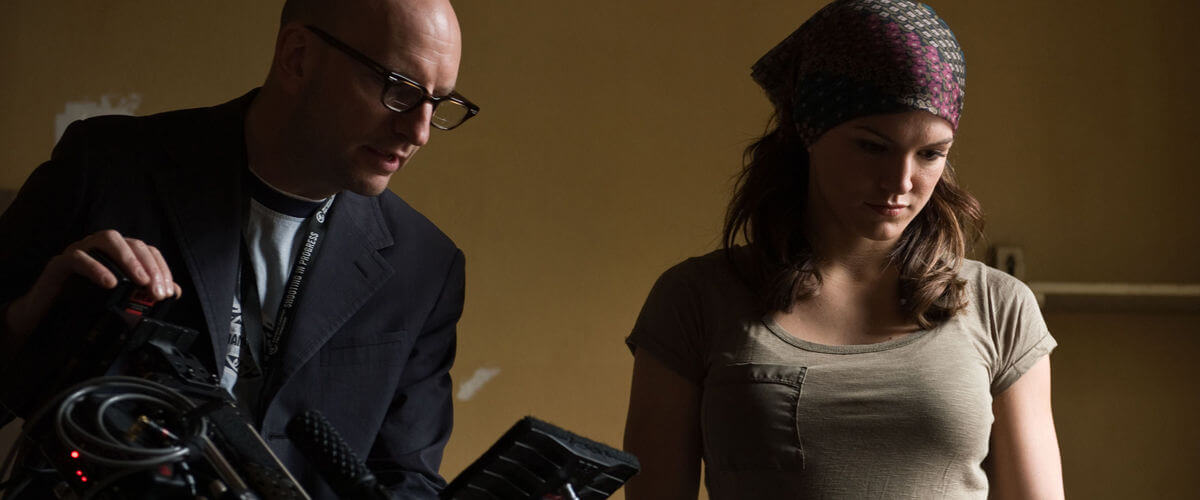
In Haywire, director Steven Soderbergh puts his penchant for inventive casting to good use, combining his affinity for ensembles with his skill at discovering unknown actors. In films like Contagion, the Ocean’s trilogy, and Traffic, he casts big names like Matt Damon, Kate Winslet, and Benicio Del Toro in key, albeit minor, roles that add consequence to a broader story. On The Girlfriend Experience, Soderbergh gave an unlikely actress, adult film star Sasha Grey, her legitimate screen debut. But for Haywire, the director makes an action hero out of mixed martial artist Gina Carano, a first-time actress whom Soderbergh discovered on television one night and, in turn, built the project around. The resulting film elevates the typical globe-trotting spy actioner into a work of formidable style and storytelling economy, a dash of hard-hitting reality thanks to Carano’s presence.
Carano plays Mallory Kane, a former-marine-turned-hired-gun whose smoky good looks give way to a lethal, spartan character not to be underestimated. We first see her entering a small coffee shop in wintry upstate New York, where she’s soon confronted by Aaron (Channing Tatum), an apparent associate. There’s a brief exchange before he attacks, and Mallory takes him down through a ruthless swap of blows. She escapes with young onlooker Scott (Michael Angarano) in his car, in which she recounts how she came to be the center of attention for international authorities and an elite group of privatized killers. Flashback to assignments in Barcelona and Dublin where she’s sent by her shifty employer, Kenneth (Ewan McGregor), the head of a clandestine firm that carries out off-the-books missions for the government. When Kenneth sells her out for money—what else?—she’s left to clear her name and seek out revenge for the betrayal.
The cloak-and-dagger plotting contains nothing audiences haven’t seen before, but screenwriter Lem Dobbs, who also wrote Soderbergh’s Kafka and The Limey, lends the proceedings a streamlined austerity and makes the story feel more sophisticated than its parts. The material’s treatment and adornments make Haywire an exceptional thriller, from Soderbergh’s casting to his formal techniques. Consider the cast of players supporting the unknown Carano: in addition to McGregor and Tatum, Michael Fassbender plays a suave but deadly MI6 agent; Michael Douglas plays a U.S. government official eager to put Mallory on the payroll; Bill Paxton plays Mallory’s father, a writer of modern warfare nonfiction; Antonio Banderas is a deliciously sinister figure who plots while stroking his graying beard. They’re all very effective in their limited roles, and as a result, they raise Carano’s role into a star-maker.
Using his usual pseudonyms (Peter Andrews as cinematographer; Mary Ann Bernard as editor), Soderbergh composes a lean 92-minute thriller, shot with elegant camerawork and pieced together through economical cutting. The visual style he deployed in earlier works is evident, with color filters and saturation expressing mood or locale. New Mexico scenes appear redder; scenes in colder climates are blue-hued; scenes involving a particular villain are rendered in black & white. He uses a 4K Red One camera for mobility and a wide range of angles, but we can always see the action. He never resorts to the industry standard “action movie style”, where handheld cameras shake about, and the frame rattles with a frenzy of unintelligibility. Rather, Soderbergh presents his action without frills, allowing Carano’s talents as a fighter and the splendid choreography to take over.
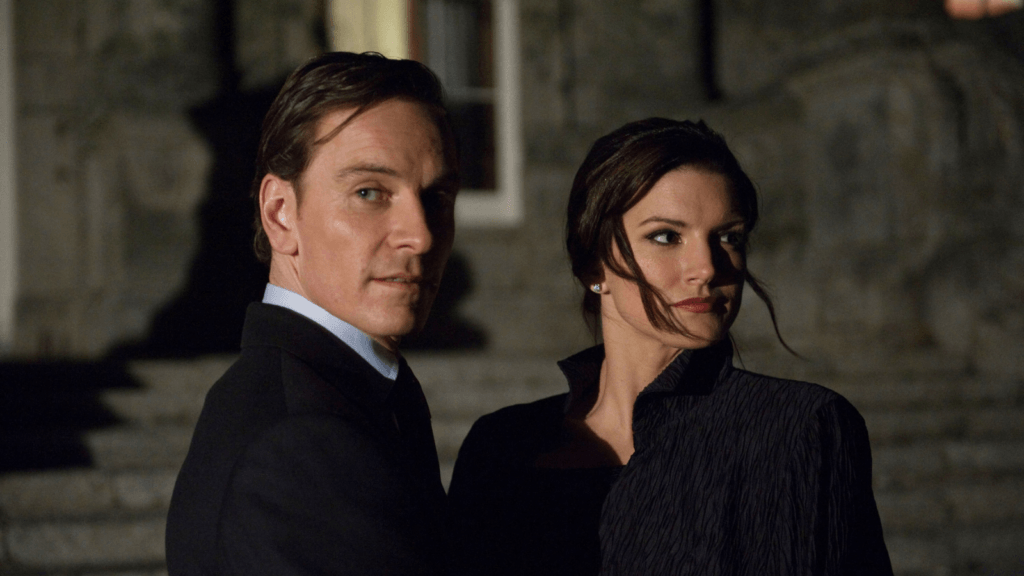
In the film’s numerous fight scenes, the music—which comes with a hip 1970s vibe courtesy of David Holmes, who also made the music for Soderbergh’s Out of Sight and Ocean’s trilogy—drops out so the audience is left with nothing except the sound of the actors. We hear only thuds and crunches during these brutal fights, but mostly we’re watching in awe as incredibly realistic bouts unfold. Carano doesn’t pull her punches, and her costars on the receiving end (Tatum, Fassbender, and McGregor) aren’t playing nice either. Soderbergh strips away the usual Hollywood ornamentation used to disguise or distract from the presence of stuntmen onscreen, and shoots from a distance to allow the viewer full visual access to Carano’s heavy-hitting and impressive delivery of foot-to-face. This is a fighter restraining herself to avoid hurting her actor co-stars, and her skill (but not her restraint) is apparent in each of the film’s extended fight sequences.
Like her character, Carano’s presence is sober, minimal, and hard-edged. She isn’t some former-model-turned-actress like Angelina Jolie or Charlize Theron, pretending her way through action scenes or gallivanting around the screen half-naked. Indeed, Soderbergh resists showing off her curves or transforming her into a sex symbol, as a more standardized production might have. Later in the film, someone says of her, “You shouldn’t think of her as a woman. That would be a mistake.” True enough, as Soderbergh resists playing up obvious sexy-female-action-hero angles by representing Mallory as a capable, tough-as-nails character. Though Carano’s beauty carries her in an evening dress in one scene, her tomboy persona never dissipates, and her authority as such gives Mallory certain command of the screen. We believe she can carry out her missions, outsmart her opposition, and exact reprisals with a believable amount of kick-ass. Though her dialogue and expressiveness are limited, Carano’s performance fits nicely into the requirements of a Jason Bourne-type character.
And with any luck, Carano will have earned herself a Bourne-esque franchise with Haywire, as the continuing adventures of Mallory Kane would be more than welcome in future sequels, especially with Soderbergh behind the camera. But as Soderbergh has recently avowed that his plans for retirement from filmmaking are moving forward as quickly as 2013, the prospect of a Soderbergh-directed sequel is doubtful. What a shame. In part, because this film is a rarity: a solid, classy action movie that avoids the genre’s formal clichésand introduces an exciting new action star. But also, because Soderbergh’s recent films (including The Informant! and Contagion) have served as a reminder that he’s one of today’s best working directors. For his continuing output—balanced between inspired independent projects and commercial films of impressive craftsmanship—to suddenly disappear would amount to a major loss to the integrity and possible ingenuity of modern cinema.
Like DFR? Support us.
This site exists because readers like you care about film. If DFR has enriched your experience with movies, I’d be grateful for your support. You have a few options:
• Join DFR’s Patreon community
• Make a one-time donation on PayPal
• Buy me a coffee
Whatever option you choose, it helps keep my work independent. And it means a lot to me.
Thank you for reading, and for making this work possible.
Brian Eggert | Critic, Founder
Deep Focus Review